Guide
B2B Local Service That Keeps Commercial Facilities Running Without any trouble
Northmark delivers B2B local service for commercial facilities: janitorial, maintenance, and audit-ready upkeep. See how we keep your building operating.
Use this page to match B2B Local Service to a real workflow, not just a generic feature list.
Request an EstimateTeams trying to apply B2B Local Service to a specific workflow.
You need practical steps, examples, and checks before taking action.
A clearer next step without turning the page into a plain article.
Why Commercial Buildings Outgrow Generic Cleaning Contracts and everything
Most facility managers are still searching for a B2B local service are not looking for a one-time cleaning. They are looking for a partner who shows up consistently, documents what was done, and escalates problems before a tenant or inspector finds them first. The frustration is almost always the same: a vendor who performs well during the proposal stage and then quietly drifts into missed tasks, undocumented visits, and reactive scrambles after something goes wrong.
Commercial properties carry obligations that residential cleaning companies and national franchise chains are not designed to support. You need coverage that accounts for high-traffic restrooms, loading dock walkways, HVAC filter logs, and emergency after-hours response. When your current vendor cannot provide a signed checklist or a timestamp on last night's service, you are already behind on what your lease, liability insurer, or compliance audit requires.
If your current service cannot produce a completed task log on request, it is time to raise the standard. Request an Estimate
What a Documented B2B Local Service Actually Looks Like
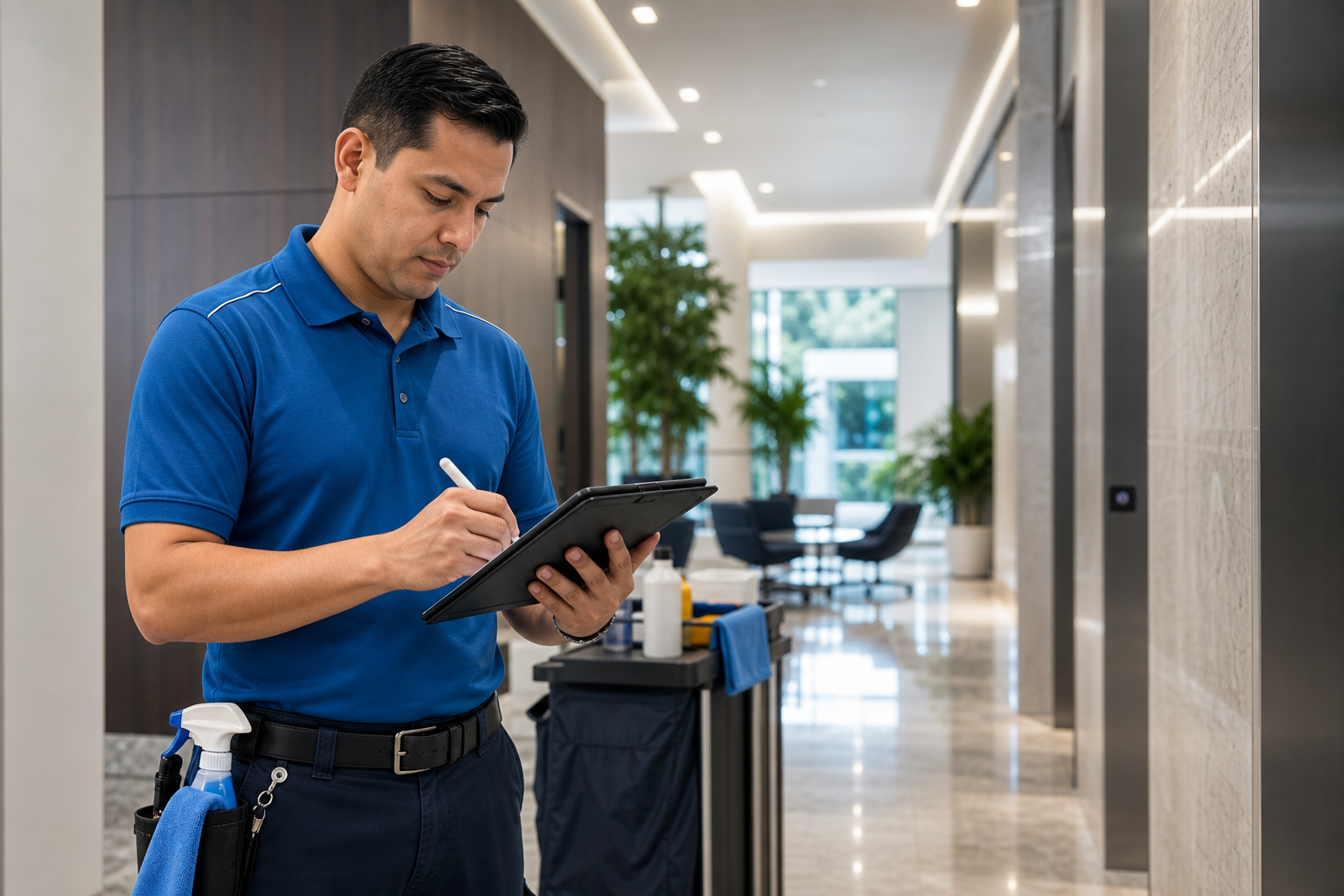
Northmark Facility Services structures every commercial account around three operational layers: scheduled maintenance visits, quality control documentation, and on-call availability for after-hours needs. Those layers are not marketing language. They translate directly into how a typical week runs for a property manager using this service.
At the start of each service cycle, crews follow written procedures specific to the property type, whether that is a multi-tenant office building, a medical office suite, or a light industrial facility. Each task is tracked against a completion record so the property manager can pull up what was done, when it was done, and by whom. That record becomes the evidence trail used during internal audits, insurance reviews, or tenant disputes about building condition.
Proactive maintenance schedules replace the reactive pattern most managers know too well: a tenant complaint triggers a call, the call triggers a rushed visit, the rushed visit misses something else, and the cycle repeats. When tasks are scheduled in advance and completion is confirmed, that cycle stops.
The Difference Between Reactive Cleaning and Facility-Grade B2B Service
Consider a scenario that facility managers in mid-size commercial buildings encounter regularly. A property with three tenant suites and shared common areas is serviced three nights per week. No task log exists. The cleaning vendor changes crew members without notice. One tenant escalates a complaint about restroom sanitation. The property manager has no record of when the restrooms were last cleaned, what standard was used, or whether the crew that night was trained on the building procedures.
That same scenario with Northmark looks different from the first week of service. Procedures are documented and matched to the physical layout of the property. Every visit produces a timestamped completion record. If a crew member changes, the replacement follows the same written procedure for that specific building. The tenant complaint, if it occurs at all, can be answered with a factual record rather than a phone call to a vendor who may not remember.
The before state is a black box. The after state is an auditable record. For any commercial property where tenants, insurers, or compliance bodies ask questions, that difference is the difference between confidence and liability.
Get a service plan built around your property type and compliance requirements. Request an Estimate
What Separates Northmark from Franchise Chains and Residential Services
The competitors most facility managers consider fall into two broad categories: national franchise cleaning brands and smaller local operators. Each has a real gap when applied to commercial B2B work.
National franchise chains often deliver residential-grade service models adapted loosely to commercial settings. Their quality control lives at the franchise level, not at the individual property level. When something goes wrong, accountability routes through a call center rather than a local team that knows your building.
Smaller local operators frequently offer competitive pricing but lack the documented procedures, quality tracking systems, and after-hours infrastructure that commercial properties require. A handshake agreement and a cell phone number are not sufficient when a burst pipe or a post-event cleanup needs to happen at 2 a.m.
Northmark operates with 24-hour availability backed by documented procedures and 100 percent quality control tracking. That combination is specifically designed for commercial property accounts where the building does not stop operating after business hours and where the standard of evidence matters as much as the standard of cleanliness.
Honest Answer: Is Switching Vendors Worth the Disruption?
The most common reason facility managers delay switching to a better B2B local service is transition cost, not price. The concern is valid. Onboarding a new vendor means learning curves, walkthroughs, and a window of time where performance may be inconsistent.
The honest answer is that the disruption of a structured onboarding is smaller and shorter than the ongoing cost of a vendor who cannot provide documentation, misses tasks without flagging them, and leaves you without coverage when something happens outside business hours. The real cost of staying is measured in tenant complaints, inspection findings, and the time a property manager spends chasing down a vendor for answers that should already exist in a service record.
Northmark uses a documented onboarding process tied to the physical layout and specific requirements of each property. The goal is to eliminate the learning curve by codifying the building before the first crew visit, not after the first complaint.
Start With a Service Plan Built for Your Specific Property
If your current B2B local service cannot hand you a task completion log, a documented procedure, or a confirmed after-hours contact, your property is carrying more operational risk than it needs to. Northmark is built for commercial facility accounts that require consistency, documentation, and responsive coverage.
Connect with Northmark to discuss your facility requirements and get a structured service plan. Request an Estimate
What types of commercial properties does Northmark service?
Northmark works with commercial property accounts including multi-tenant office buildings, medical and professional office suites, light industrial facilities, and retail properties that require routine janitorial service, facility upkeep, and scheduled maintenance. If your property has documented compliance or inspection requirements, that context is built directly into the service procedures for your account.
How does quality control tracking work on a commercial account?
Each service visit is completed against a written task checklist specific to the property. Completion records are maintained and available to the property manager. This creates an auditable log of what was done, when it was completed, and which procedures were followed. The tracking is not a summary report after the fact. It is a running record tied to each visit.
What does after-hours availability actually cover?
After-hours availability means Northmark can respond to commercial facility needs outside standard business hours. This includes post-event cleanups, emergency response situations, and scheduled overnight service for properties where daytime work would disrupt operations. Coverage is structured into the service agreement rather than handled as a separate on-call request.
Can Northmark support a property that has to meet specific audit or inspection standards?
Yes. Documented procedures and audit-ready standards are a core part of how Northmark structures commercial accounts. If your property is subject to internal audits, tenant lease requirements, or regulatory inspections, the service procedures and completion records are designed to produce the evidence trail those reviews require. Specific standards can be discussed during the onboarding walkthrough.
How does the onboarding process work when switching from a previous vendor?
Onboarding begins with a walkthrough of the physical property and a review of the tasks, frequencies, and standards the account requires. Written procedures are created for the specific building before the first service visit. This means the crew arrives with documented instructions rather than general training, which reduces the inconsistency period that makes switching vendors feel risky.